
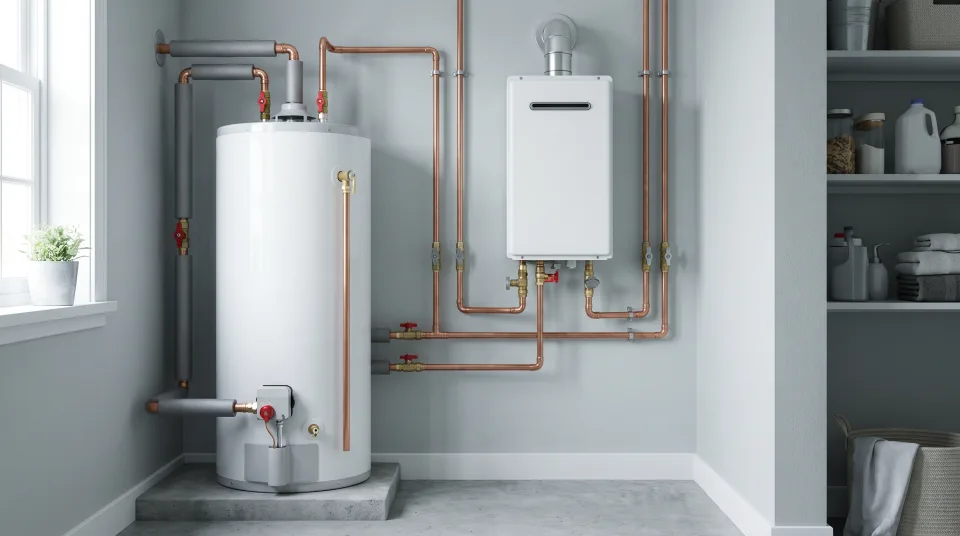
For most Charlotte homes, a like-for-like tank is the cheaper choice up front, and a tankless unit earns its higher price back slowly through lower energy use and a longer life. Which one wins comes down to your gas line, how much hot water you use at once, and how long you plan to stay.
What each one costs, installed
A standard tank swap is the least expensive path. A tankless unit costs more to buy, and switching from a tank to tankless costs the most, because it adds new venting and usually gas-line work.
| Setup | Installed range |
|---|---|
| Gas tank (40–50 gal) | $1,400–$2,200 |
| Electric tank (40–50 gal) | $1,250–$1,850 |
| Tankless, like-for-like | $2,600–$4,200 |
| Tank to tankless conversion | $3,000–$5,000 |
Typical installed ranges in the Charlotte metro, before NC sales tax. The exact number is confirmed on site.
Why a conversion costs more
A tankless burner fires far harder than a tank to heat water on demand, so a tank-to-tankless conversion is more than a swap. The old tank vent cannot be reused, the gas line is often upsized, and some homes need a larger meter or regulator from Piedmont Natural Gas.
- New venting sized for the tankless unit
- A larger or new gas line where the current one is undersized
- A condensate drain on a condensing model
- Sometimes a larger gas meter or regulator from the utility
The payback math
A tankless unit is more efficient than a standard atmospheric tank, so it trims the hot-water part of the energy bill. The savings are real but modest, so the payback is measured in years, not months. The stronger case is longevity: a tankless unit lasts about 20 years against a tank’s 8 to 12, so you buy one instead of two over that stretch.
Add the things a spreadsheet misses. Hot water does not run out mid-shower, and a wall-mounted unit gives back the floor space a tank takes up. Those are the reasons most Charlotte homeowners who go tankless are glad they did.
See the installed range for your exact setup in about 30 seconds.
Or call for a quote: (704) 555-0100
When tankless makes sense, and when a tank does
Tankless is the better fit for a larger household that runs out of hot water, a long-term owner who will see the payback, or a tight utility closet where the wall-mounted unit frees up room.
A tank is the better value for a like-for-like replacement on a budget, an all-electric home with no gas service, or a shorter stay where the upfront premium will not be recovered. There is no wrong answer here, only the one that fits the house.
Rebates, credits, and the water here
Duke Energy’s rebate is for heat-pump water heaters, not tankless, and the federal energy-efficiency credit for water heaters ended after 2025. Piedmont Natural Gas runs a rebate program for qualifying gas equipment, which is worth checking at the time of install rather than counting on a set figure.
One local note: Charlotte’s water is soft, so scale builds slowly. A tankless unit still needs the manufacturer’s descaling on schedule to keep the warranty and the efficiency, and the plumber sets that expectation when the unit goes in.