
Water heater guide · Charlotte, NC
How to Tell Your Water Heater Is About to Fail
A tank almost always warns you before it quits. Here are the signs to watch for, so you can replace on your own schedule instead of mopping up a flooded floor.
A water heater usually warns you before it quits. Rusty hot water, popping from the tank, water pooling at the base, or a unit past 10 years are all signs the end is near. Catch them early and you replace on your own schedule instead of mopping up a flooded floor.
The signs your water heater is failing
Any one of these is worth a look; two or more usually means it is time to plan a replacement.
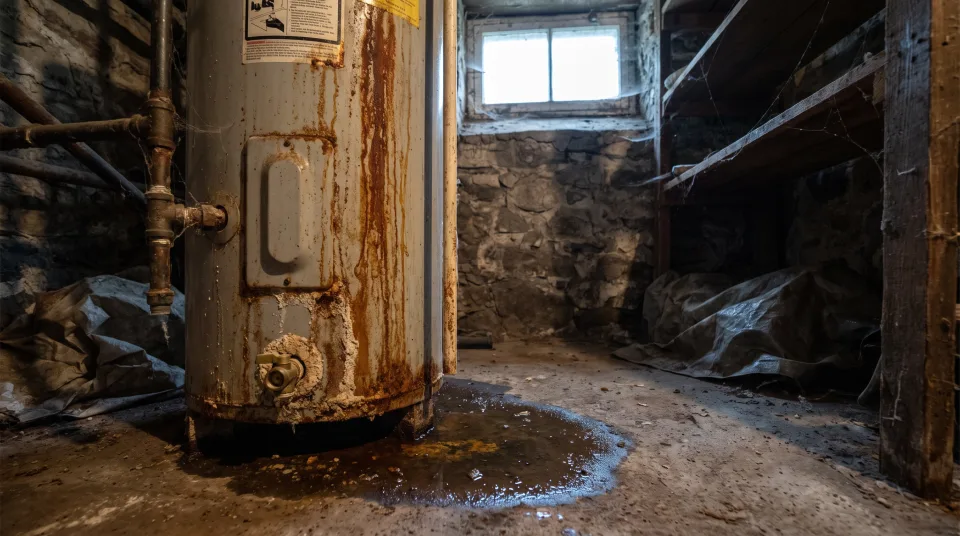
- Rusty or discolored hot water. when only the hot side runs brown or metallic, the tank is likely corroding from the inside.
- Water pooling at the base. the most serious sign. A drip at a valve or fitting is fixable, but water from the tank body means it has rusted through.
- Popping or rumbling. a layer of hardened sediment on the tank floor, which makes the burner work harder and shortens the tank’s life.
- Hot water that runs out fast. sediment eating into capacity, a worn dip tube, or a tank that has quietly aged past its prime.
- A unit past 10 to 12 years. at that age a failure is a question of when, not if, even if it still runs today.
- Rising bills or slow recovery. a tank straining to reheat is often on its way out.
Which signs mean repair, and which mean replace
The fix-or-replace call comes down to three things: where the leak is, the age of the unit, and the cost of the repair against a new one.
- A leak from a valve or fitting on a newer unit is a repair.
- A leak from the tank body has failed and needs replacing.
- Past 10 to 12 years, or a repair over about half the price of a new unit, replacement wins.
The water heater repair in Charlotte page walks through the repair-versus-replace rule in more detail, with the common repair costs by part.
Wondering what a replacement would run? See the range for your setup in about 30 seconds.
Or give us a call for a quote: (704) 842-9891
How long a water heater lasts
A storage tank lasts about 8 to 12 years and a tankless unit about 20. Where a unit lands in that range comes down to upkeep, and Charlotte’s soft water is on your side, since scale forms slowly here.
How to get more years out of it
Much of what shortens a tank's life is preventable. A yearly flush clears the sediment that makes a tank work harder, a fresh anode rod every few years takes the corrosion instead of the steel, and setting the thermostat to 120 degrees eases the wear while trimming the energy bill and the scald risk.
What to do if it is leaking right now
Shut off the cold-water valve at the top of the tank. On an electric unit switch off its breaker; on a gas unit turn the control to off. Then call, and send a photo of the unit and where it sits so we can quote a replacement range before anyone comes out.
What a replacement costs when it is time
When the signs point to replacing, a like-for-like swap is a predictable job. The water heater replacement cost in Charlotte page has the installed ranges by size and fuel, before NC sales tax. Catching it early lets you replace on a planned visit instead of an emergency one.
FAQ
Water heater warning signs, answered
What Charlotte homeowners ask when a tank starts acting up.
How long does a water heater last?
A storage tank lasts about 8 to 12 years, and a tankless unit about 20. Charlotte’s soft water is easy on a tank, so a well-maintained one can reach the top of that range.
Is a leaking water heater an emergency?
Shut off the water to the tank and call. A leak at a valve or fitting is often a straightforward repair, but water coming from the tank body means the tank has failed and needs replacing before it floods.
Does rusty hot water mean I need a new water heater?
Often, yes. If only the hot water is rusty, the tank or its anode rod is corroding. A plumber can confirm whether a new anode buys time or the tank is too far gone.
Can maintenance make a water heater last longer?
Yes. Flushing the sediment out every year or two and replacing the anode rod before it is spent both add years. It is the cheapest way to reach the upper end of a tank’s lifespan.
Related pages and guides
Think your water heater is on its way out?
Same-week service across the Charlotte metro