
Water heater guide · Charlotte, NC
Heat-Pump Water Heater: Is It Worth It in Charlotte?
It is the cheapest water heater to run, and it comes with a Duke rebate, but it is not right for every home. Here is the honest case, for and against.
A heat-pump water heater uses two to four times less energy than a standard electric tank, which often makes it the cheapest option to run, and Duke Energy pays a $500 rebate on a qualifying 50-gallon unit. It costs more up front and needs an open, above-freezing space, so it fits a Charlotte garage or basement better than a tight closet.
How does a heat-pump water heater work?
It does not make heat, it moves it. A fan pulls warmth from the surrounding air across a refrigerant coil and transfers it into the tank, the same reverse-refrigeration idea as an air conditioner or a fridge. Because it moves heat rather than generating it with an element, it runs two to four times more efficient than a standard electric tank. It keeps resistance elements as backup for heavy demand, which is why it is also called a hybrid.
How much does it save, and what does it cost?
Depending on household size and use, a heat-pump unit saves roughly $100 to $550 a year against a standard electric tank. It costs more up front than a standard tank, so the payback is about 5 to 7 years on its own, or 2 to 4 years once the Duke rebate is applied. It lasts about 13 to 15 years. Installed ranges are on the replacement cost in Charlotte page.
The Duke rebate, and the expired federal credit
Duke Energy pays $500 for a qualifying 50-gallon unit and $800 for an 80-gallon one. The unit must be ENERGY STAR certified with a uniform energy factor of at least 3.3, and you need a free Duke Home Energy Check within the last 24 months. Standard electric, gas, and tankless units do not qualify.
One thing to know: the federal 25C tax credit ended for units placed in service after December 31, 2025, so a 2026 install gets no federal credit. The payback now leans on the Duke rebate plus the running-cost savings, not a federal write-off.
What it needs (the honest cons)
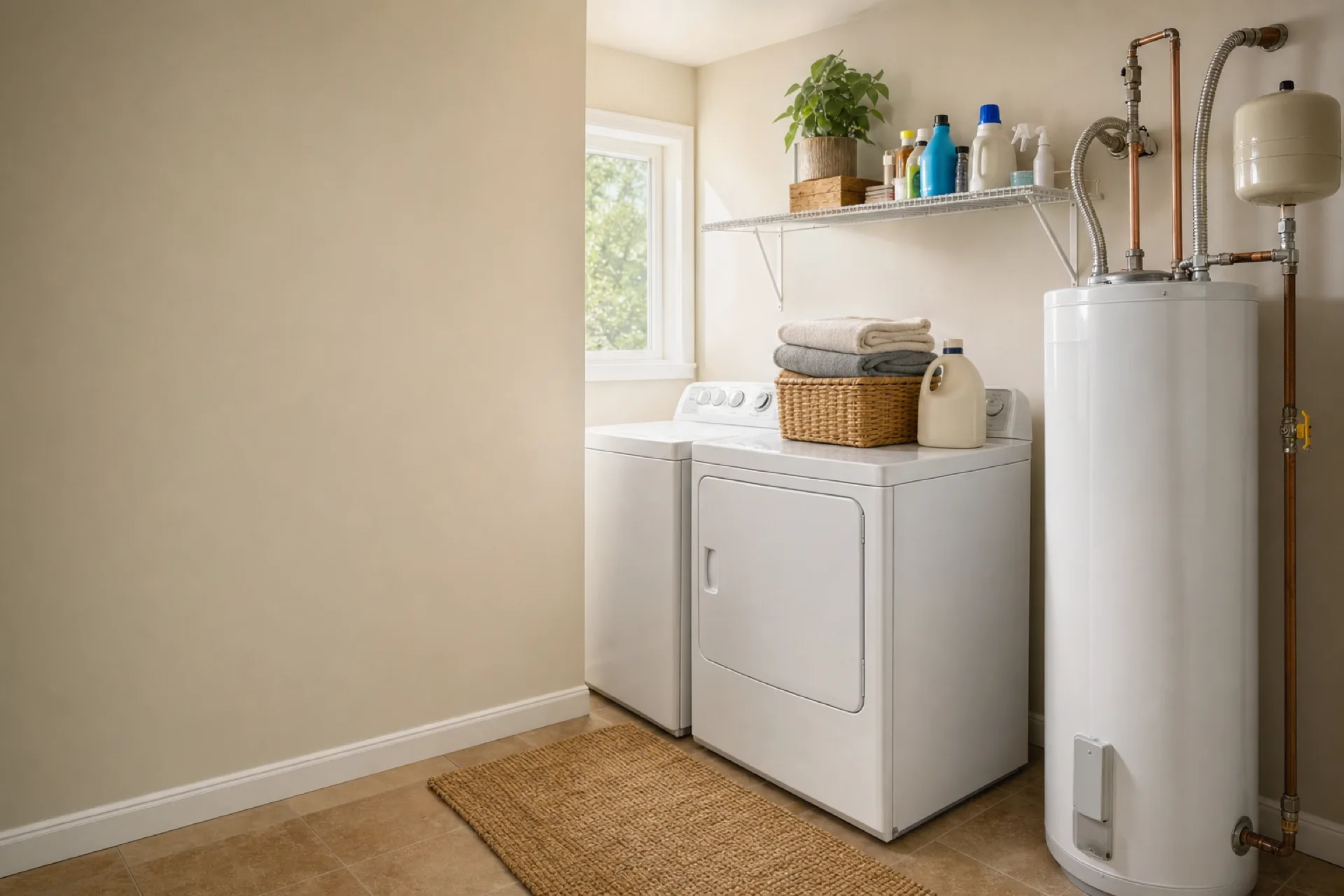
- An open space that stays about 40 to 90 degrees with roughly 1,000 cubic feet of air. A garage, basement, or large mechanical room, not a tight closet.
- It blows out cool, dehumidified air. A plus in a hot garage in summer, a minus next to a finished living space in winter.
- The fan and compressor run at background-conversation volume, more noticeable than a silent tank.
- It makes condensate that has to drain, and it usually wants a 240-volt circuit, which a like-for-like electric swap already has.
Is it worth it in Charlotte?
For most of the year Charlotte’s moderate climate and the region’s common garages and basements line up well with the space a heat-pump unit needs. The strongest case is a home replacing a standard electric tank that has the room for it: the running-cost savings and the Duke rebate do the work. The weaker case is a tight interior closet or an unheated garage that runs cold on winter mornings.
Thinking about a heat-pump unit? Get an installed range for your home in about 30 seconds.
Or give us a call for a quote: (704) 842-9891
FAQ
Heat-pump water heaters, answered
What Charlotte homeowners ask before going hybrid.
Does a heat-pump water heater qualify for a rebate in Charlotte?
Yes. Duke Energy pays $500 for a qualifying 50-gallon unit and $800 for an 80-gallon one, for residential electric customers. The unit must be ENERGY STAR certified with a uniform energy factor of at least 3.3, and you need a free Duke Home Energy Check within the last 24 months. Standard electric, gas, and tankless units do not qualify.
Is a heat-pump water heater worth it without the federal tax credit?
The federal 25C credit ended for units placed in service after December 31, 2025, so a 2026 install gets no federal credit. It can still pay off on running-cost savings plus the Duke rebate, especially when you are replacing a standard electric tank and have the space for it.
Will a heat-pump water heater work in my garage?
Usually yes, and a garage is a common spot. It needs an open space that stays between about 40 and 90 degrees with roughly 1,000 cubic feet of air around it. On the coldest winter mornings an unheated garage can dip below that window, and the unit falls back on its backup elements until it warms up.
How much does a heat-pump water heater cost to run?
A lot less than a standard electric tank. Depending on household size and use, savings run roughly $100 to $550 a year. Payback is about 5 to 7 years on its own, or 2 to 4 years once the Duke rebate is applied, and the unit lasts about 13 to 15 years.
Related pages and guides
Get a heat-pump water heater quoted
Same-week service across the Charlotte metro